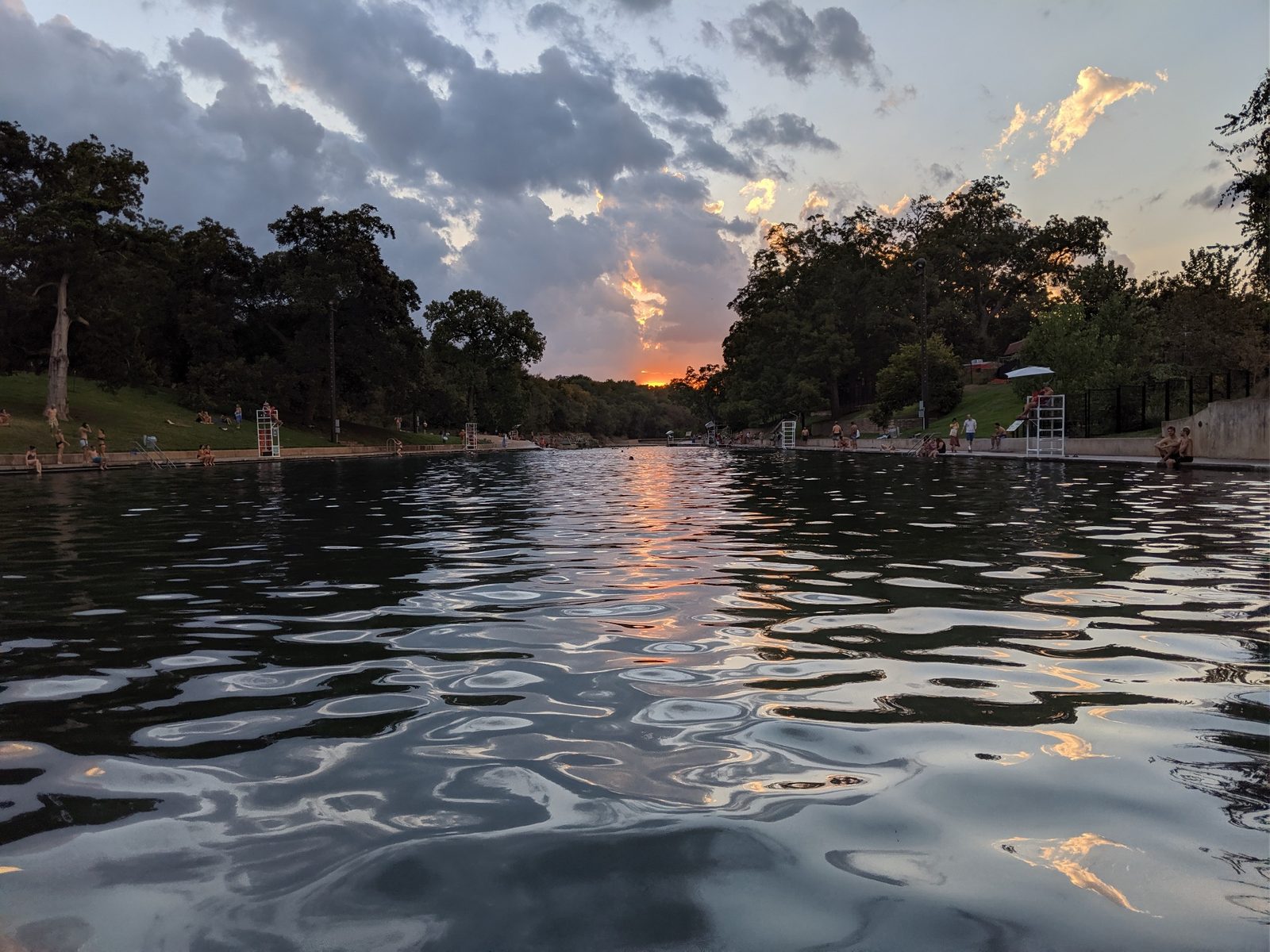
I went to Texas on what felt like a whim a few years back.
It was snowing in Colorado at the time. I had just returned from a work trip (or at least it felt that way) and something was calling me. Not metaphorically. Much more physically. Much more like electricity. I couldn’t wait to plan it anymore. I acted.
My key goal, for reasons I couldn’t fully articulate, was to go to Barton Springs Pool.
I remember crossing mountains wrapped in cloud. The abrupt change in weather. Finding a hotel for the night along the way in Texas and, before leaving, handing the maître d’ a small handful of snow that hadn’t melted from the back of the truck.
“A gift from Colorado,” I said, “like all gifts in this life… temporary.”
His mouth hung open as I drove on.
I worked during the week, and the time I wanted for the spring never quite appeared. When the weekend finally arrived, I had made a friend who took me to Hippy Hollow on Lake Travis on Saturday. I lay on the shore in the sun, and suddenly a rock announced itself beneath my belly. When I pulled it free, it had a faint green hue (like the lake itself) and a hole through its center. A small hollow. Space to contemplate.
A philosopher’s rock, I thought.
I noted it in my journal. After staring at it for a while, I slipped it into my bag to carry with me.
Sunday, the next day, tired and feeling a bit chilled from the lake, I wasn’t sure I would make it to the spring at all before I left Texas. Taking a lazy morning, I tried to research the rock I’d found at Lake Travis, and when I searched “philosopher’s rock,” something unexpected appeared.
A sculpture in Austin.
A sculpture called Philosopher’s Rock, located on the promenade in front of Barton Springs.
I knew then that I had to go.
What I had actually been thinking of, I realized, was a scholar’s stone—gongshi in Chinese tradition. Scholar’s stones are naturally occurring (or subtly shaped) rocks, appreciated by certain kinds of people. They are often made of karst limestone—stone shaped and pitted by water, soluble under the right conditions, slowly hollowed into contemplation.
The same kind of limestone that runs beneath Austin. The same stone threaded through Barton Springs.
Why did my mind reach for Philosopher’s Rock when I was really searching for a Scholar’s Stone—and what does it mean when the place itself answers a misnaming?
When I arrived at the park where the pool and spring are, I wandered through the old caretaker’s house and spoke with a young man at the desk. He told me there was once a hidden bunker in the garden, no longer accessible to the public. And I told him the story of how I ended up there because of a rock. Departing the house, heading towards the water, I saw the sculpture: three men seated around that very rock.
Philosopher’s Rock—sometimes called Bedi’s Rock—was once the name of a limestone shelf that rose from the edge of Barton Springs. On hot days, the naturalist Roy Bedichek and the folklorist J. Frank Dobie would sit there for hours, talking about literature, nature, and tall tales of lost treasure. Their close friend, the historian Walter Prescott Webb, often joined them. Together, the three helped shape a distinctive intellectual climate in Texas, one that reached far beyond the state.
For reasons I didn’t yet understand, I was drawn (pun intended) to Roy.
Without realizing that the stone was sometimes called Bedi’s Rock, I sat down and drew his figure. I copied one of his quotes into my journal. A young girl stood nearby, watching intently, until her mother eventually tugged her away.
I wish you might be here and go with me on a sunny afternoon to Mt. Bonnell or up Barton Creek. Everywhere it is beautiful. I think we could settle most of the world’s problems to our satisfaction. And a thousand years from now friends such as we will wander over these same hills, inhaling the same scents and feasting their eyes upon the same beauty…
—Roy Bedichek (1878–1959)
I closed my journal.
And then I entered the spring.
After changing, finding a safe entry point, and planning my exit (necessary considerations when you’re disabled), I stepped into the water. Cool. Nearly cold. But I was determined to float.
I did, near the center.
Buoyant because of my disease, I stared up at the passing clouds while feeling the water press evenly around me. Had those clouds been here before? In this very spring? Over a long enough timeline, it seemed obvious that all water must have been everywhere.
But does it desire?
Does it want to return to a particular place? A particular state? Not a well in the way we drill them, but an entanglement well of sorts, drawing matter, energy, and attention together at specific moments, for reasons we don’t yet understand.
Does water carry memory?
Does water want?
When I grew too cold, I had to leave. A storm was rolling in. I walked to the far end of the pool, where the water spills out toward freedom and people still play just beyond the walls. I sat facing the setting sun and sketched the clouds through the trees, eating a little honey to soothe my sore throat.
A lifeguard passed and told me I couldn’t sit so close to the water, the lightning was coming. Thunder called me home.
I was hungry. It was my last day in Austin before returning to Colorado.
Still thinking about the scholar’s stone from Lake Travis and how it had led me, indirectly, to the Philosopher’s Rock, I looked up the wood traditionally used to hold a gongshi.
Rosewood.
Searching Rosewood in Austin led me, unexpectedly, to a restaurant called Rosewood, less than five minutes away. The restaurant was nearly empty. I sat at the bar. They served me tea with local honey, and a seven-course special on a quiet Sunday night.
I couldn’t have asked for a better way to round out my time there.
Some of the seeds planted that day have lingered, grown, shifted, and changed form.
What led me down that path?
And where, now, am I going next?
Leave a Reply